
Bricksforge
Unauthenticated Arbitrary File Upload
This blog post covers a Critical unauthenticated arbitrary file upload vulnerability in the Bricksforge plugin for WordPress. Patchstack has deployed a mitigation rule to protect against exploitation of this vulnerability. If you are a Bricksforge user, update to at least version 3.1.8.10.
This vulnerability is currently being targeted in the wild. Tracked as CVE-2026-85097, the issue allows unauthenticated attackers to upload and execute arbitrary PHP code on vulnerable WordPress websites, leading to remote code execution (RCE). It affects Bricksforge versions up to and including 3.1.8.9. A fix is available in version 3.1.8.10, and organizations running affected versions should upgrade as soon as possible.
Our telemetry shows active exploitation attempts targeting Bricksforge installations, with activity first observed on October 7, 2026, at 21:47 UTC.
| CVE | CVE-2026-85097 |
| Product | Bricksforge |
| Vulnerability Type | Unauthenticated Arbitrary File Upload / RCE |
| CVSS | 10.0 (Critical) |
| Exploitation Status | Active exploitation observed |
| Authentication Required | No |
| Affected Versions | ≤ 3.1.8.9 |
| Fixed Version | 3.1.8.10 |
| Vendor Advisory | Bricksforge changelog |
| First Observed Exploitation | October 7, 2026, 21:47:17 UTC |
✌️ Our users are protected from this vulnerability. Are yours?
Identify vulnerabilities in your plugins and get recommendations for fixes.
Request auditProtect your users, improve server health and earn additional revenue.
Patchstack for hostsAbout the Bricksforge plugin
Bricksforge is a WordPress plugin designed to extend the functionality of Bricks Builder, a visual website-building tool for WordPress. It provides additional features for building dynamic and interactive websites, including advanced forms, animations, custom interactions, dynamic data management, and backend customization.
How the vulnerability works
Bricksforge validates a file’s MIME type when it is first uploaded. When a form is later submitted, however, it trusts the file metadata the client sends. In particular, it does not validate the url field inside the temporaryFileUploads parameter. That gap gives attackers a four-step path to code execution:
- Request a valid nonce from the unauthenticated
bricksforge_regenerate_nonceAJAX endpoint. - Upload a GIF/PHP polyglot: a file that is a valid image but also contains PHP code. It passes the MIME check and lands in the temporary upload directory.
- Submit a form where the
filepath points to that validated image, but theurlends in a PHP extension. - Bricksforge trusts the submitted metadata and places the file’s contents at the PHP location. When that file is requested, the server executes the embedded code.
The result is arbitrary PHP execution on the server. From there, an attacker can deploy web shells, modify site content, read sensitive data, and establish persistent access.
The code location where metadata is injected via temporaryFileUploads:

[…]
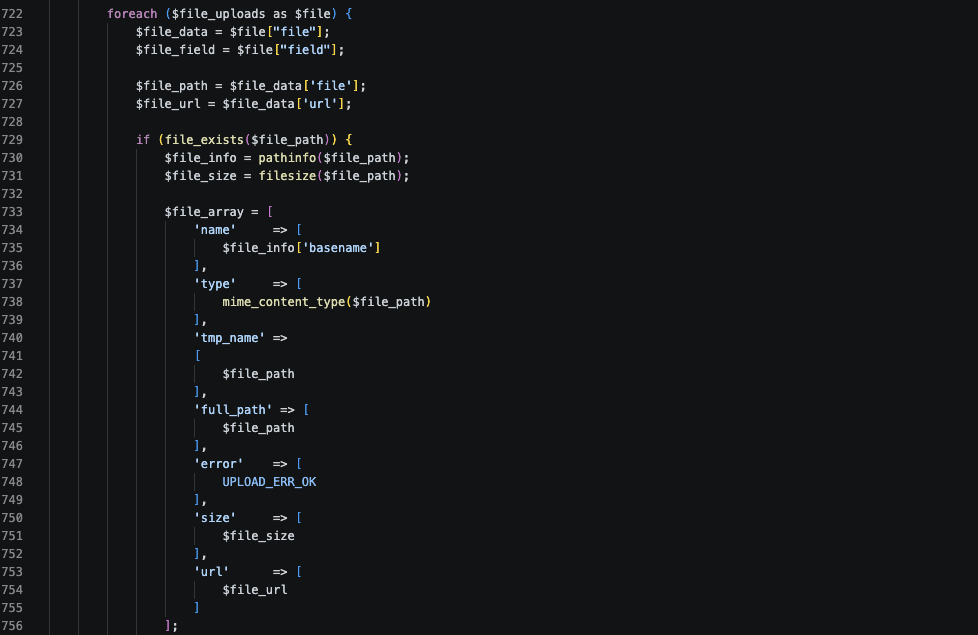
bricksforge/includes/elements/pro-forms/actions/init.php
The code location that subsequently allows arbitrary file uploads:
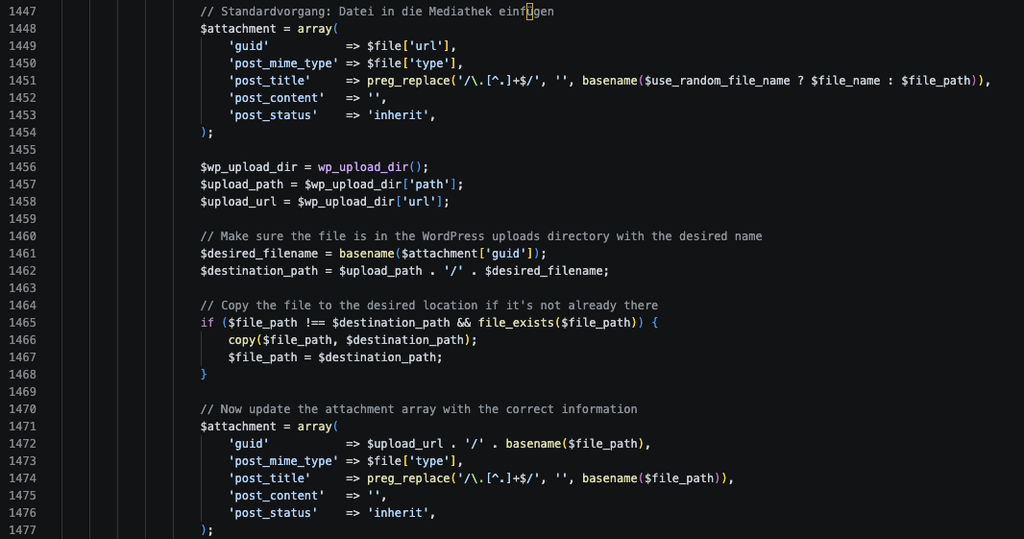
bricksforge/includes/elements/pro-forms/actions/base.php
What we’re seeing
All but one of the exploitation attempts targeted the Bricksforge REST API form submission endpoint:
POST /wp-json/bricksforge/v1/form_submitThe remaining request hit /wp-admin/admin-ajax.php with the bricksforge_form_submit action. Every request included a crafted temporaryFileUploads parameter. Here is a representative payload, normalized from the structure we observed:
{
  "temporaryFileUploads": [
    {
      "field": "form-field-file",
      "file": {
        "file": "/var/www/example.com/wp-content/uploads/bricksforge/tmp/img_example.gif",
        "url": "https://example.com/wp-content/uploads/bricksforge/tmp/img_example.php",
        "type": "image/gif"
      }
    }
  ]
}
The key signature is the mismatch: the server-side path is an image, and the destination URL is a PHP file. In 95% of captured requests, the server-side path ended in .gif or .png, and most of those paired it with a PHP-related destination URL.
Most payloads referenced files in the Bricksforge temporary directory, /wp-content/uploads/bricksforge/tmp/. Some aimed further. These used destination filenames matching login_admin_*.php to place PHP files in the regular WordPress uploads directory, such as /wp-content/uploads/2026/10/.
Payload variations
Attackers are actively probing for ways around extension filtering. We observed four kinds of variation:
- Alternative PHP extensions:
.php,.php5,.php7,.php8,.phtml,.pht,.phtm, and.phps. - Case manipulation:
.PHP,.Php,.pHp, and.PHTML. - Encoded extensions: URL-encoded and double-encoded forms such as
%2ephp,.%70hp, and.%2570%2568%2570. - Modified metadata: altered or missing
path,name,originalFilename, andurlfields, used to test how the plugin validates and processes files.
Signs of coordinated, automated activity
Two clusters stand out in our telemetry. In the first, 44 IPs sent 56 requests with identical payloads within seconds of each other. In the second, three IPs tested 25 variations of PHP extensions and encodings against the same temporary file.
Both patterns point to automated exploitation over rotating proxies or distributed infrastructure. They do not, on their own, attribute the activity to a single threat actor.
Source IP addresses
We recorded 63 unique source IPs. The six most active accounted for about 46% of all requests:
| IP address | Network | AbuseIPDB reports | CleanTalk blacklist |
|---|---|---|---|
| 177.75.57.20 | EXPLORERNET (Brazilian fixed-line ISP) | 8 | No |
| 23.97.62.146 | Microsoft Azure | 1,270+ | No |
| 84.247.60.125 | HostRoyale | 12 | Yes |
| 38.154.185.97 | B2 Net Solutions | 11 | Yes |
| 150.109.16.166 | Tencent | 185 | Yes |
| 153.75.90.146 | Cloudzy (Datacenter) | 35 | Yes |
The infrastructure is mixed: datacenter servers, cloud providers, VPN and proxy services, and residential or fixed-line ISP connections. The most active address, 177.75.57.20, is the outlier. It sits on a Brazilian fixed-line ISP rather than in a datacenter, and it has almost no prior abuse history.
Detection
Review your HTTP and application logs for these indicators:
- Requests to
/wp-json/bricksforge/v1/form_submitthat contain atemporaryFileUploadsparameter. - Upload metadata where an image path (
.gif,.png) is paired with a PHP-related destination URL. - Calls to the
bricksforge_regenerate_nonceAJAX action, followed by an upload and a form submission. - Repeated form submissions cycling through file extensions, encodings, or capitalization.
- Unexpected PHP files in
/wp-content/uploads/bricksforge/tmp/or any other uploads directory, especially files namedlogin_admin_*.php. - HTTP requests to newly created PHP files in upload directories.
If a site ran a vulnerable version without protection, review historical logs and the host itself for unexpected PHP files, unusual application activity, and unauthorized changes.
What to do now
Update Bricksforge to version 3.1.8.10 or later. That closes the vulnerability.
If you can’t update right away, Patchstack’s RapidMitigate rule for CVE-2026-85097 blocks these exploitation attempts at the traffic layer, without touching plugin code. The rule was live before the first attack arrived, which is the point: close the window between disclosure and exploitation, before attackers can use it.
We’re continuing to monitor this campaign for new payload variations and bypass attempts, and we’ll update this post as the activity evolves.
🤝 You can help us make the Internet a safer place
Streamline your disclosure process to fix vulnerabilities faster and comply with CRA.
Get started for freeProtect your users too! Improve server health and earn added revenue with proactive security.
Patchstack for hostsReport vulnerabilities to our gamified bug bounty program to earn monthly cash rewards.
Learn more