For hosts & platforms
NodeJS & supply chain security

Your customers are shipping vibecoded apps. Their risk is sitting on your infrastructure.

Patchstack brings continuous NodeJS/NPM vulnerability intelligence to web hosts and platforms — surfacing exactly which dependency is vulnerable so you can guide customers straight to the fix.

Your least technical customers are shipping the most unreviewed code you've ever hosted.

01

They didn't choose their dependencies

NodeJS is now the dominant technology among vibe-coding tools, used by the same non-technical customer who used to build on WordPress — and expects that same experience, including security.

02

They can't track what changes after deploy

Open-source dependencies keep changing after an app ships. Expecting a business owner to monitor package maintainer reputation and supply chain risk is beyond what can be expected of the average user.

03

When they get hacked, they blame you

By the time a compromised app surfaces, trust is broken, churn risk is elevated, and support is overloaded with inquiries that could've been prevented.

🔐 🛡️ 🚀

"AI has made it much easier to build applications, but security doesn't end at deployment. Open-source dependencies keep changing, so developers need ongoing visibility into new vulnerabilities — not just a one-time scan."

Patchstack logoOliver Sild's avatar

Oliver Sild

CEO, Patchstack

The model

The same playbook that made us the market leader in WordPress, now built for NodeJS.

Today, this is vulnerability intelligence: your customers get told exactly which dependency is vulnerable and which update fixes it. Automatic mitigation — the same vPatching model we run for WordPress — is coming soon for NodeJS. Read the technical docs →

01

Continuous scanning, not a one-time check

Applications on your platform are continuously scanned for newly disclosed vulnerabilities in their dependencies — the risk gets caught as it emerges, not months later.

02

Customers get alerted and told exactly what to update

When something's flagged, your customers are automatically alerted and pointed to the fix — which vulnerable package, which version to update to — before a vulnerability turns into a support ticket or a breach.

03

Runs in the background — nothing for them to configure

No setup required from the customer. Security becomes part of your hosting offering, not a separate concern they have to go find a tool for.

04

Automatic mitigationComing soon

The same automatic protection rules we run for WordPress, extended to NodeJS dependencies — so vulnerabilities get blocked, not just flagged.
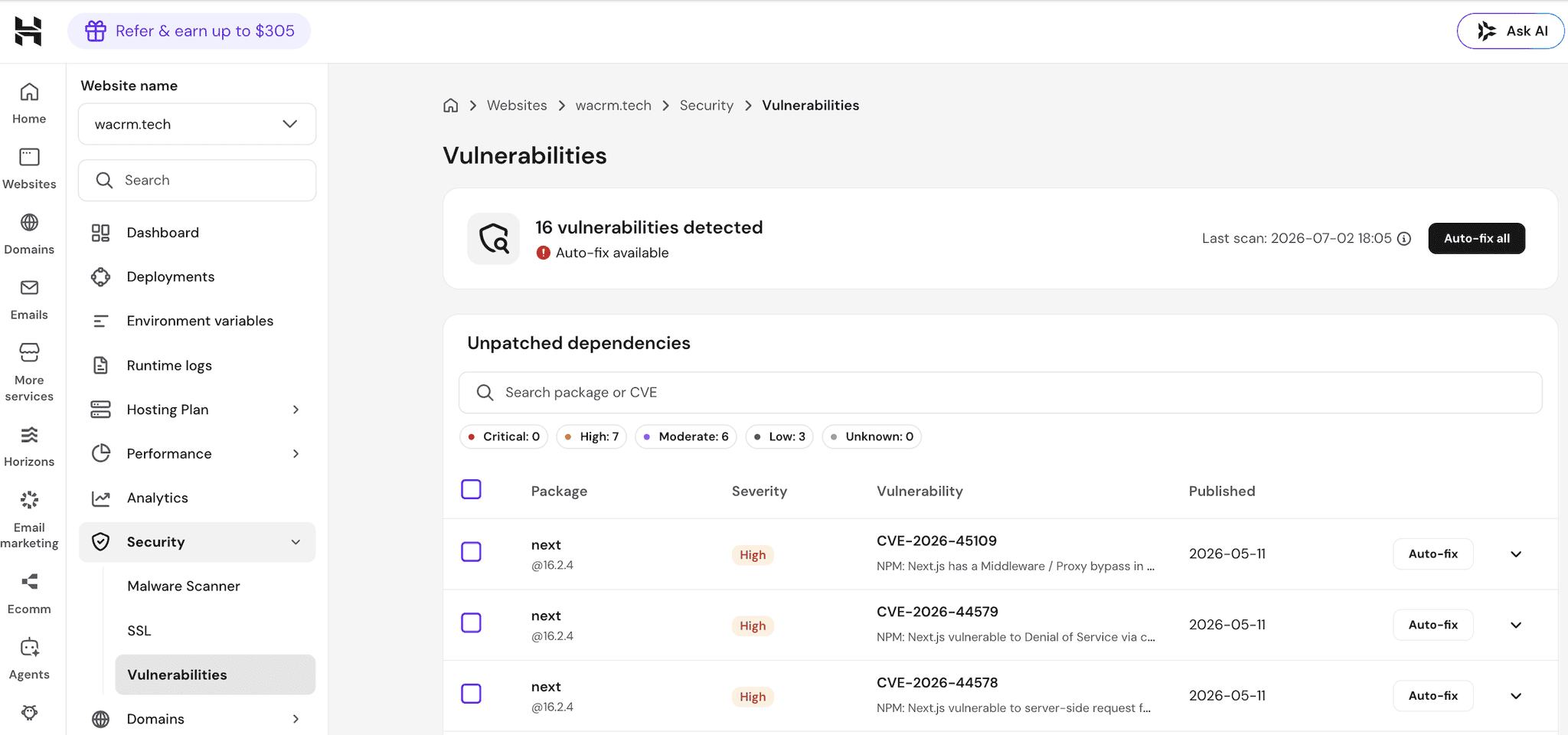
Case study

How Hostinger built vulnerability intelligence into its Node.js hosting.

HostingerLive partnership

Patchstack, built into Hostinger's Node.js hosting

  • Continuous scanning for newly disclosed dependency vulnerabilities
  • Automatic alerts pointing customers to the exact fix
  • Background monitoring, zero setup required
  • Enabled by default across Hostinger's Business web hosting and cloud plans
Hostinger's Node.js hosting dashboard showing Patchstack vulnerability intelligence integration
🌍 🔒 ⚡

"When you're building with AI tools, you're focused on getting the product live, not on what happens to your dependencies six months later. That's where the risk builds up, and that's what this partnership with Patchstack is designed to handle."

Hostinger logoArnas Donauskas's avatar

Arnas Donauskas

Web Hosting Product Manager, Hostinger

Get in touch

Let's talk about what this looks like on your platform.

Whether you're an existing Patchstack partner or a host we haven't worked with yet, if your customers are shipping apps built on dependencies they didn't write, this is worth the conversation. Tell us a bit about your platform and we'll reach out.

  • Already a Patchstack partner? This is an expansion of what you already have — not a new sale.
  • New to Patchstack? We'll walk you through what an integration looks like from scratch.
  • No commitment required to have the conversation.

Questions

Common questions

We already partner with Patchstack for WordPress — is this a new product?
No. NodeJS/NPM coverage is part of your existing Threat Intelligence API access, not a new sale. For existing Patchstack partners, this is an expansion of what you already have.
We're not a Patchstack partner yet — can we still do this?
Yes. This isn't limited to existing partners — if you're a hosting provider or platform whose customers are shipping NodeJS apps, reach out and we'll scope out what an integration would look like for you from the ground up.
Do our customers need to install or configure anything?
No. Monitoring runs in the background with no setup required from the customer — it is part of the hosting experience they already have.
Can developers use this directly, without a hosting partner?
Yes. Patchstack maintains @patchstack/connect, an official open-source npm package that connects any JavaScript/Node.js project to Patchstack vulnerability monitoring. See the installation documentation for what it does and how to set it up.
What does this actually protect against?
Today, this is vulnerability intelligence: continuous scanning for newly disclosed vulnerabilities in application dependencies, with automatic alerts telling customers exactly which package and version to update to fix it. Automatic mitigation — like the vPatching we run for WordPress — is coming soon for NodeJS.
Is this only for Node.js?
The current rollout covers NodeJS/NPM vulnerability protection and supply chain security. Patchstack is already the market leader in the equivalent WordPress model.
What happens after I submit the form?
Our partnerships team reaches out to learn about your platform and walk through what an integration could look like for you and your customers.

We already did the hard part.

Give your customers security they never had to ask for.